
 2025-06-09
 Shenzhen Beta Co., Ltd
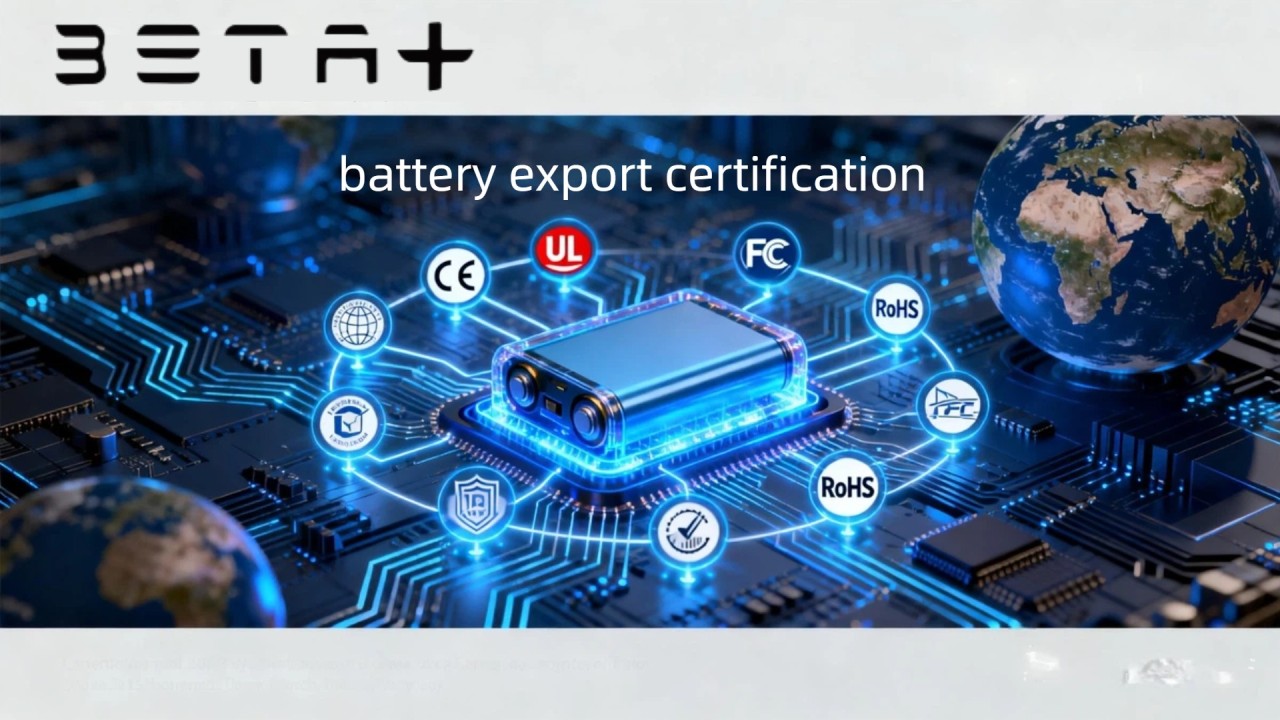
The core certifications for household storage batteries exported are divided into two main categories: internationally recognized basic certifications and country/region-specific access certifications.
According to the policy requirements of different governments, manufacturers usually try to invest in certifications for their main markets. Let's take a look at what common certification requirements are currently on the market.
Essential Global Basic Certifications (Required in Any Market)
These are the 'passports' for export, involving safety, transportation, and environmental protection, and are prerequisites for subsequent market certifications.
1,UN38.3 Transport Safety Certification
Mandatory requirement for international air, sea, and land transportation of lithium batteries, verifying safety tests such as high-altitude simulation, thermal shock, vibration, short circuit, and compression. Single packages with more than 24 cells / 12 battery packs require additional drop tests. Must be accompanied by aviation / maritime transport inspection reports.
2,CB Certification (IECEE CB Scheme)
A globally recognized safety certificate based on IEC standards, which can be converted into certifications in multiple countries (such as CE, UL, Australian certification, etc.). The core standards include IEC 62133 (battery safety) and IEC 62619 (energy storage batteries), significantly reducing the cost of repeated testing.
3, Basic Battery Regulatory Compliance
EU Battery Regulation (EU 2023/1542): Fully implemented in August 2025. Batteries with a capacity ≥2 kWh require a carbon footprint declaration, cobalt/lithium/nickel recycling rate ≥70%, and the attachment of a traceable QR code; starting in 2026, a battery passport will be implemented.
RoHS: Restricts hazardous substances such as lead and cadmium, with supporting environmental requirements for CE certification.
REACH: Substances of Very High Concern (SVHC) >0.1% must be declared, and an SDS (Safety Data Sheet) must be submitted.
Regional Core Certification + Special Requirements
1, The European Union and European Countries
CE is a mandatory mark in the EU, covering LVD (Low Voltage Directive) and EMC (Electromagnetic Compatibility) directives. Household storage batteries also need to comply with grid connection and local power grid standards.
Safety: EN 62619 (safety of large-scale energy storage batteries), EN 62133 (battery safety), EN 62477-1 (power conversion equipment)
Low Voltage (LVD): 2014/35/EU, EN 62368-1
Electromagnetic Compatibility (EMC): 2014/30/EU, EN 61000 series
Special Grid Connection Requirements EU General: EN 50549 (low voltage / medium voltage grid connection)
2, North America
Known for strict safety and grid-connection standards, centered around the UL series, with some being mandatory / required by e-commerce platforms.
UL 9540: Overall safety of energy storage systems (ESS), including thermal runaway and electrical fire protection, suitable for residential scenarios.
UL 1973: Safety of stationary energy storage battery packs, assessing extreme conditions such as overcharge, over-discharge, and short circuits.
UL 9540A/9540B: Thermal runaway propagation testing, mandatory by fire authorities in regions such as California.
FCC: Wireless functions (e.g., Bluetooth monitoring) must pass EMC testing to prevent electromagnetic interference.
CSA Certification (equivalent to UL standards, such as CSA C22.2 No.107.3), and grid connection must comply with local electrical codes
3, Asia-Pacific Market
Australia & New Zealand Safety: RCM mark (SAA certification + EMC registration), standards AS/NZS 62619, AS/NZS 62368.1
Grid connection: AS/NZS 4777.2 (distributed generation grid connection); without this, it cannot be connected to the grid
Subsidy requirement: CEC listing (Clean Energy Council), otherwise government subsidies cannot be applied for, and installers will not procure
Southeast Asia: Type 5 (long-term compliance, annual audit) or Type 1B (batch certification), compliant with IEC 62619, MS 45, etc. TISI certification; MIC certification; SNI certification, all based on IEC standards + different country local deviation tests
4,Middle East & Latin America
Middle East Saudi Arabia: SASO certification (submitted via SABER electronic system), IEC 62619 + SEC grid connection requirements
United Arab Emirates: ESMA certification, IEC 62477 + DEWA grid connection standards, technical documents required in Arabic
Latin America Mexico: NOM certification (mandatory safety certification), compliant with IEC 62133 and UL standards
Brazil: INMETRO certification, grid connection must comply with local grid regulations, some states require additional environmental filing
Which would be your main market and in your market is there any special certification / test report needed to better enter the market ?
Leave us a message and teach us how to get them easily
